Engineering a 16K Multi-Channel Analyzer for High-Purity Germanium Detectors

In nuclear physics and radiation metrology, the quality of gamma-ray spectroscopy hinges entirely on two import sections: the fundamental resolution of the detector crystal and the precision of the processing electronics. While standard Sodium Iodide (NaI(Tl)) scintillators perform well within the bounds of a 1K or 4K Multi-Channel Analyzer (MCA), high-performance semiconductor detectors - such as High-Purity Germanium (HPGe) systems - demand orders of magnitude higher resolution.
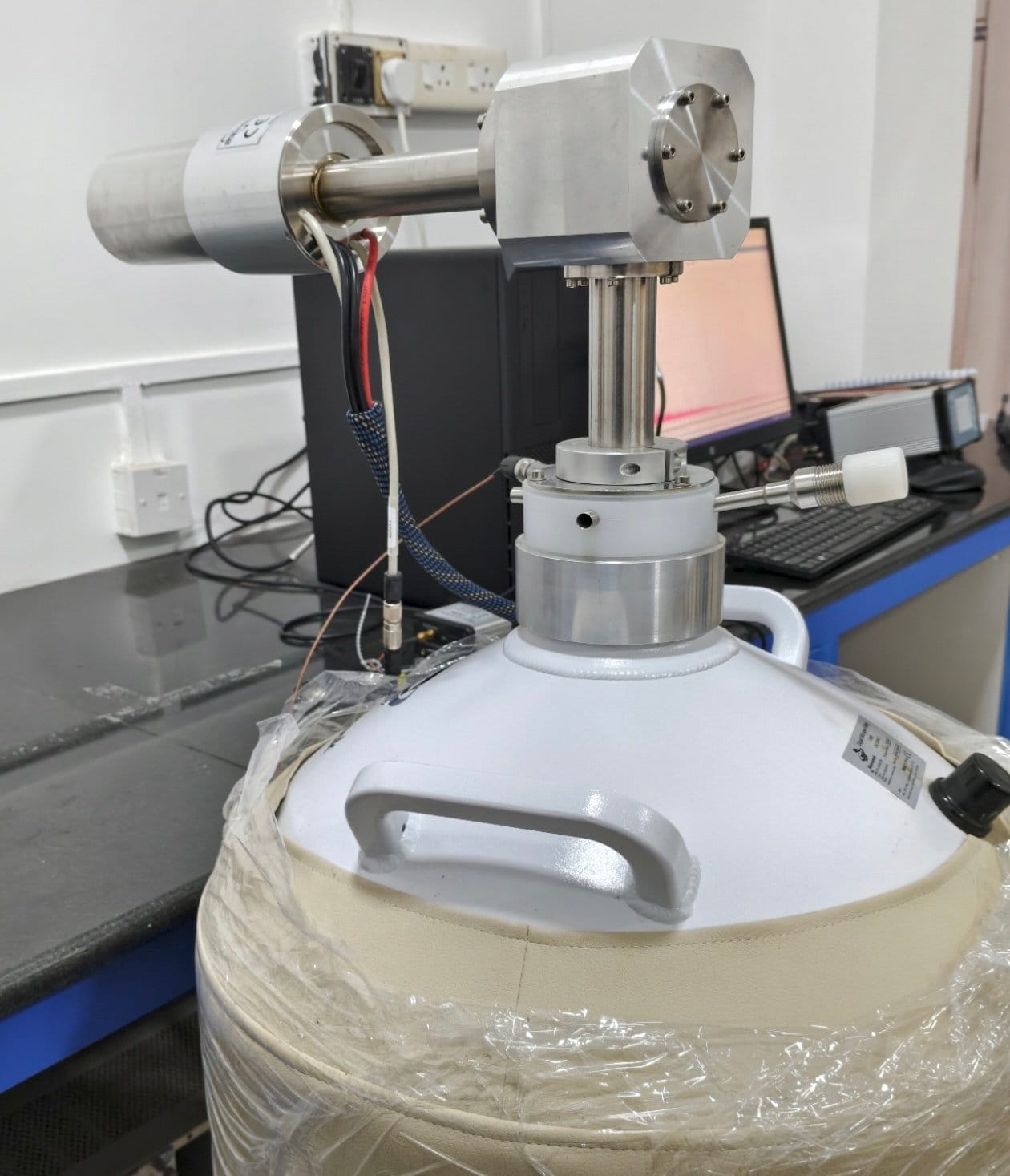
To capture the ultra-sharp, tightly packed photopeaks characteristic of an HPGe detector, standard digitization resolution is simply insufficient. This technical brief details the development, simulation, hardware integration, and verification of my 16K-channel Multi-Channel Analyzer system designed to work with HPGe. Many thanks to Dr Vinod at the University of Calicut for letting me use his system, and Student Aswin for helping out.
Analog Frontend Circuit Design & KiCAD Simulation
I modeled the analog frontend in KiCAD to simulate the transient behavior of the peak detector. The circuit must hold the absolute maximum voltage of a shaped pulse long enough for a high-resolution ADC to execute a complete conversion cycle, without introducing distortion or severe drop-out. KiCAD's SPICE plugin agreed remarkably well with what I saw on the oscilloscope. It's pretty cool that you can plug in the values for the individual components from the datasheet, and find explanations on various phenomena, for example that 20mV dip caused by the junction capacitance of the dual schottky diodes. Q= CV = .830*1e-6 . Now subtract the charge held by the BAT54S and recalculate the voltage. It's a pretty consistent offset of about 50 channels out of 16K.

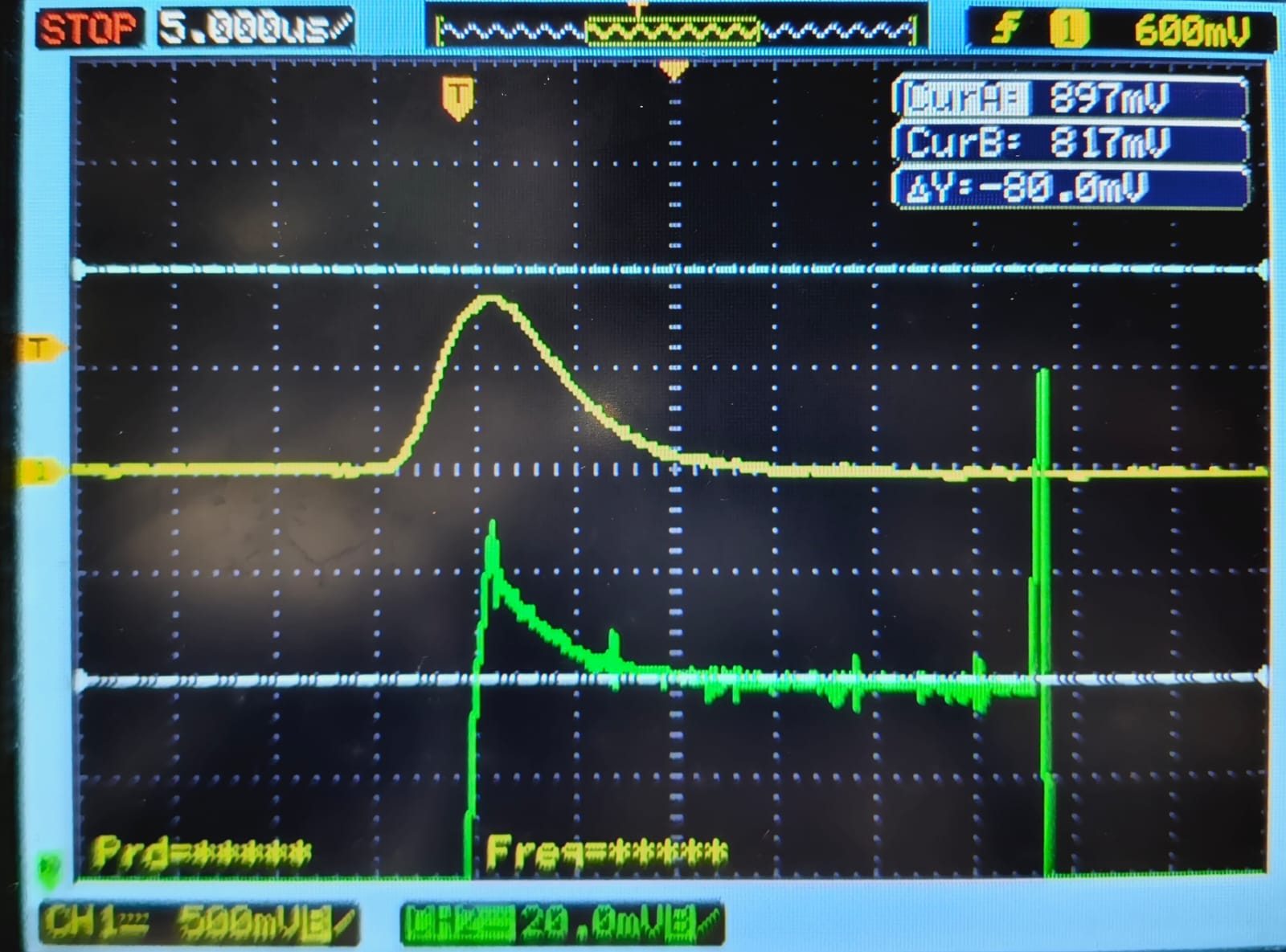
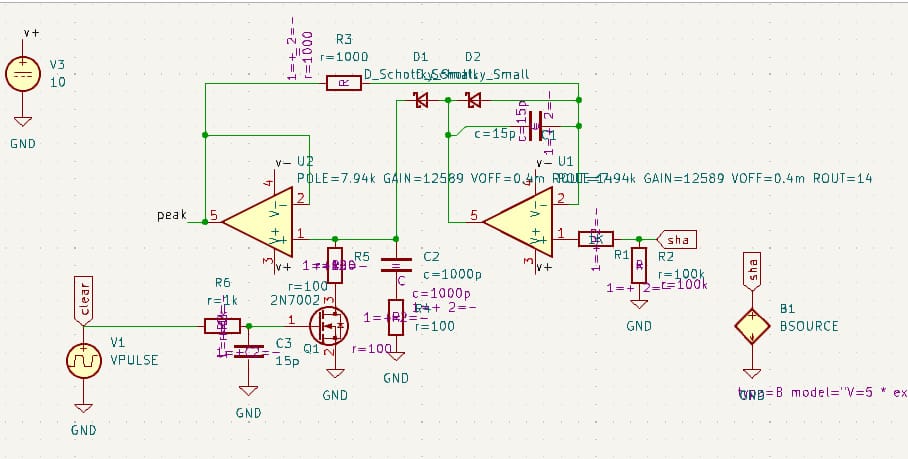
Peak Detection Circuit Simulation with KICAD and SPICE. It was difficult to feed values for multi-part symbols like dual opamps and the dual schottky, so I replaced them with discrete components and input the values separately.
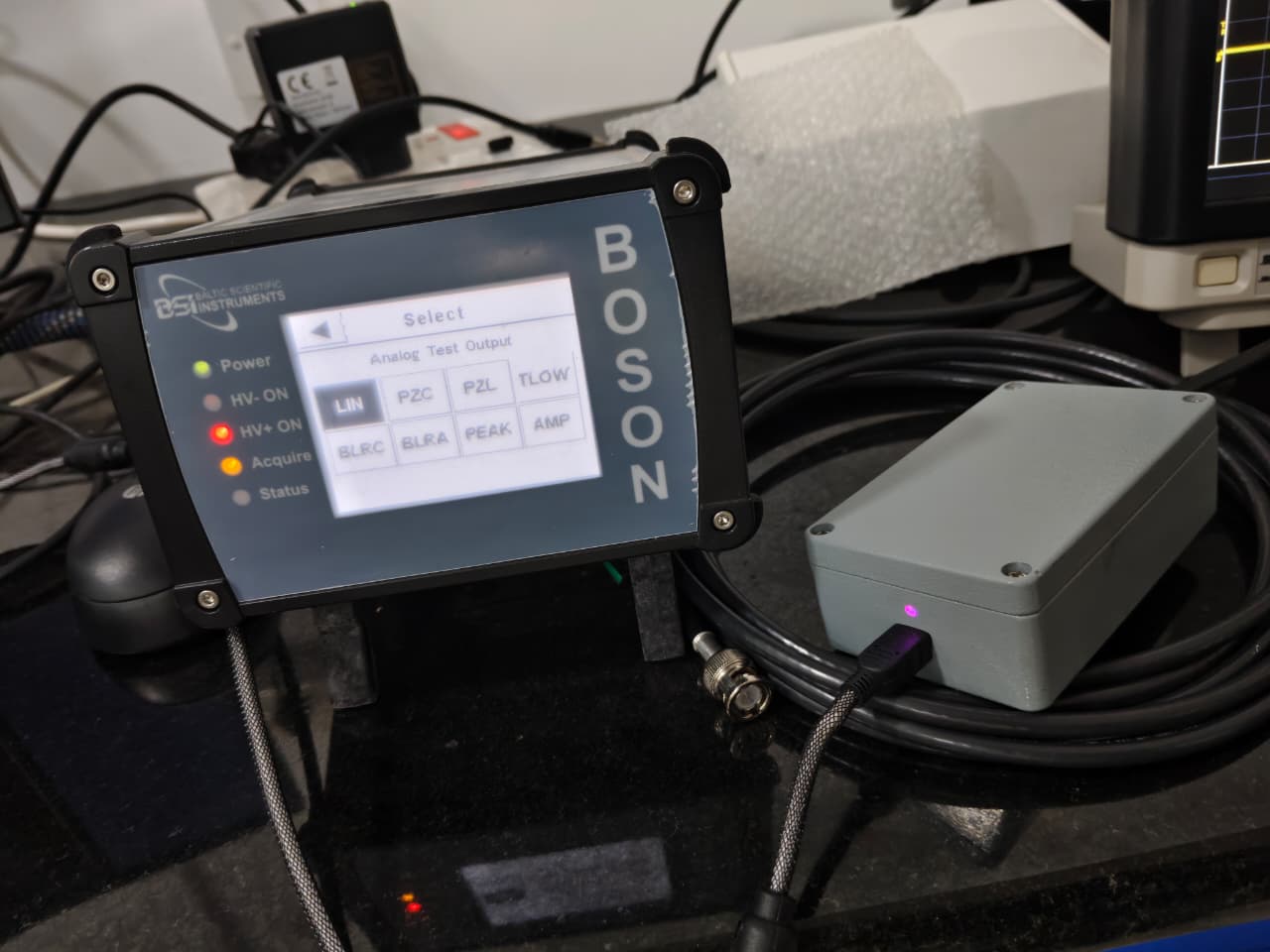
The MCA was connected to the analog out of the BSI BOSON: a high-performance detection backplane developed by Baltic Scientific Instruments. I had to set the output type to LIN (Stretched pulse) because the shaped pulse output had some issue and looked like a 5V TTL regardless of gain settings.
Energy Calibration via Cesium-137 (137Cs)
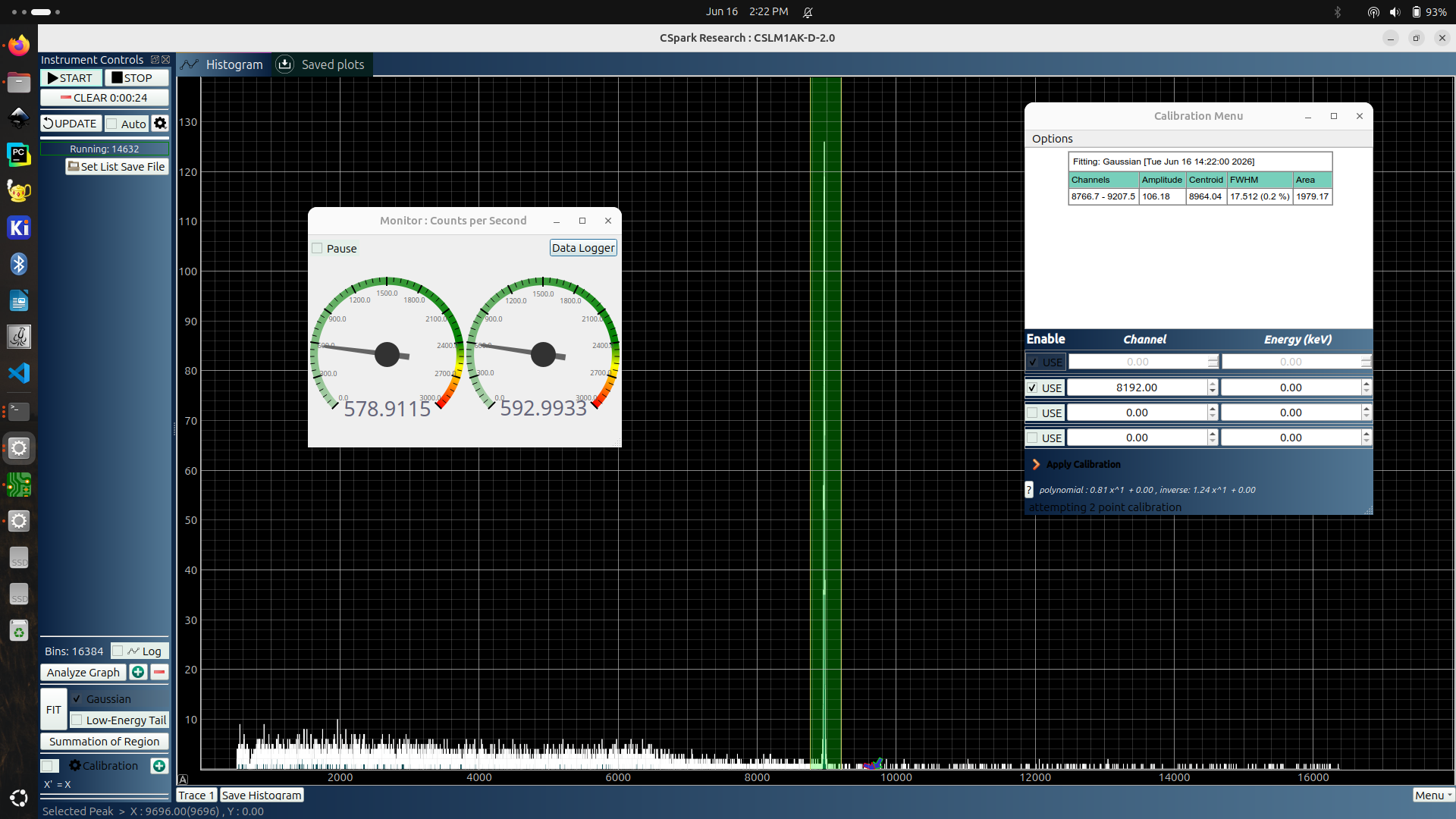
A Multi-Channel Analyzer inherently measures pulse height in terms of raw digital bins (channels 0 to 16,383). Transforming these abstract channels into calibrated energy units (keV) requires precise multi-point calibration. Initial validation was carried out using a standard monoenergetic Cesium-137 (137Cs) reference source.
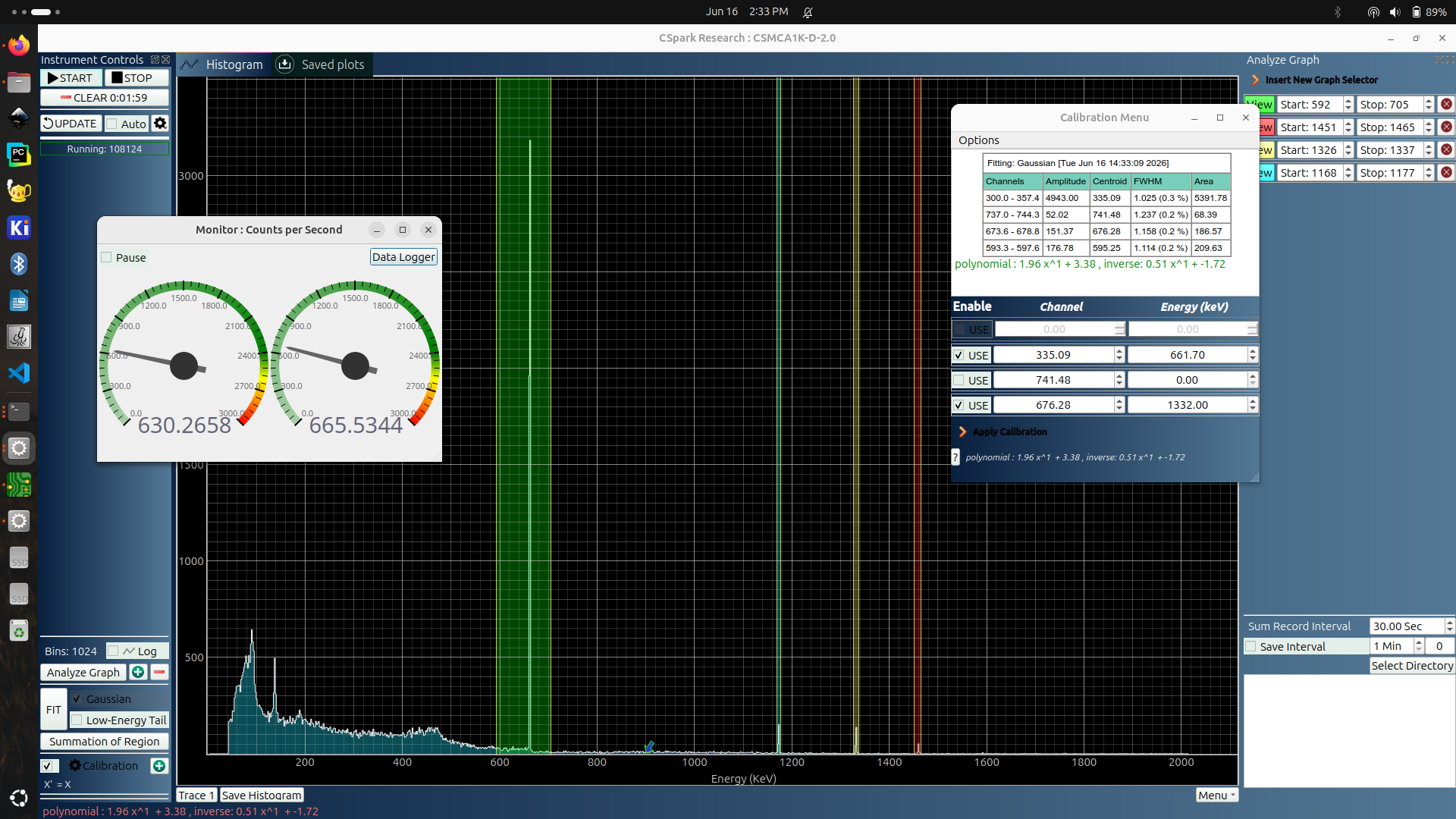
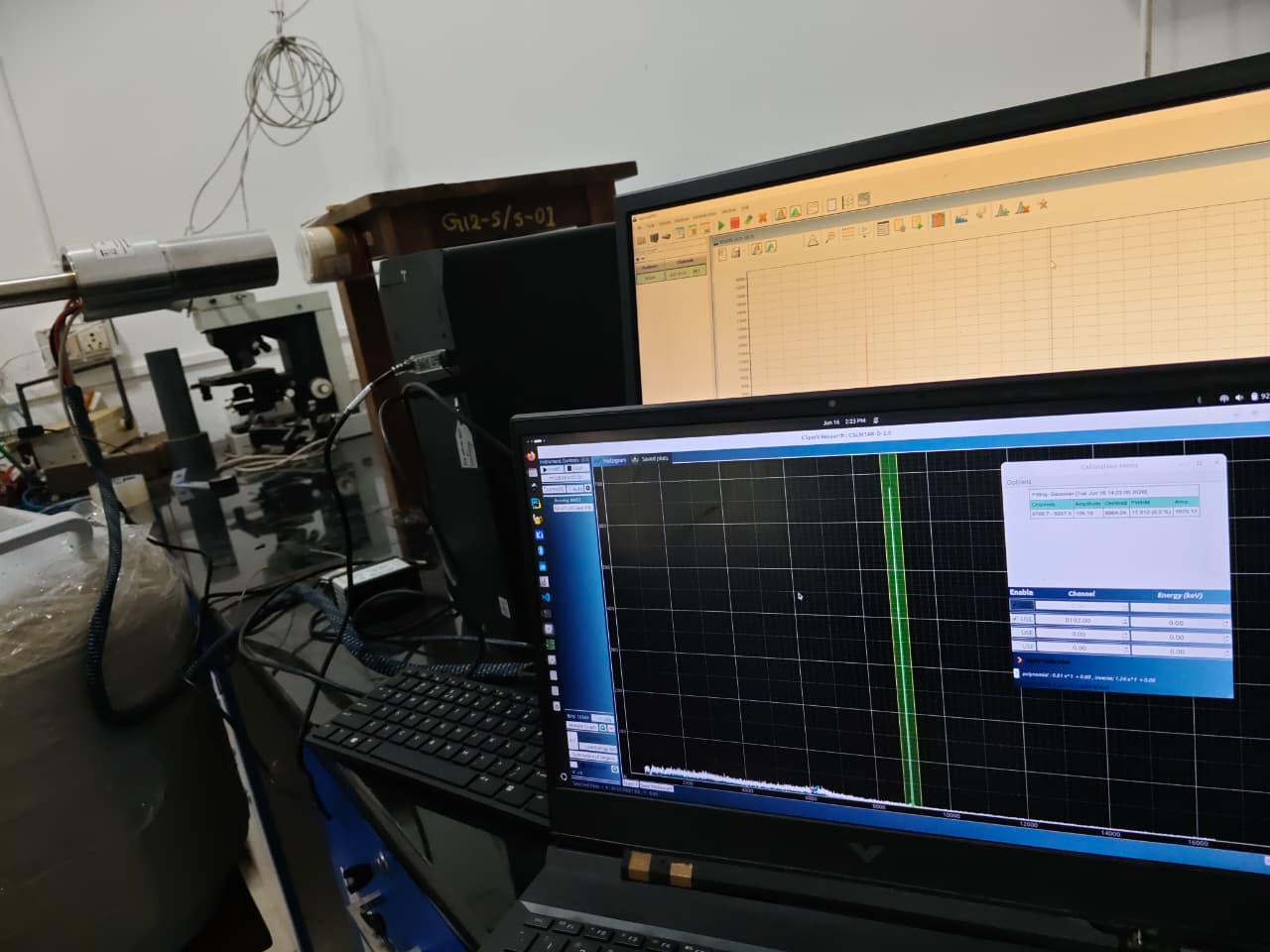
The resulting spectrum exhibits a a clean photopeak at E=661.7 keV (Centroid channel 8964.04). The full width at half maximum (FWHM) of the peak was very good at under 0.2%. This provides an unprecedented look at the intrinsic resolution of the HPGe system and verifies that the ADC sampling clock possesses minimal jitter.
Multi-Nuclide Linearity and Performance Testing
While calibrating to a single photopeak establishes a baseline, a spectroscopic system is only as dependable as its linearity across the entire dynamic range. An ideal MCA must maintain a strictly linear relationship:
$$Channel=m * Energy + c$$
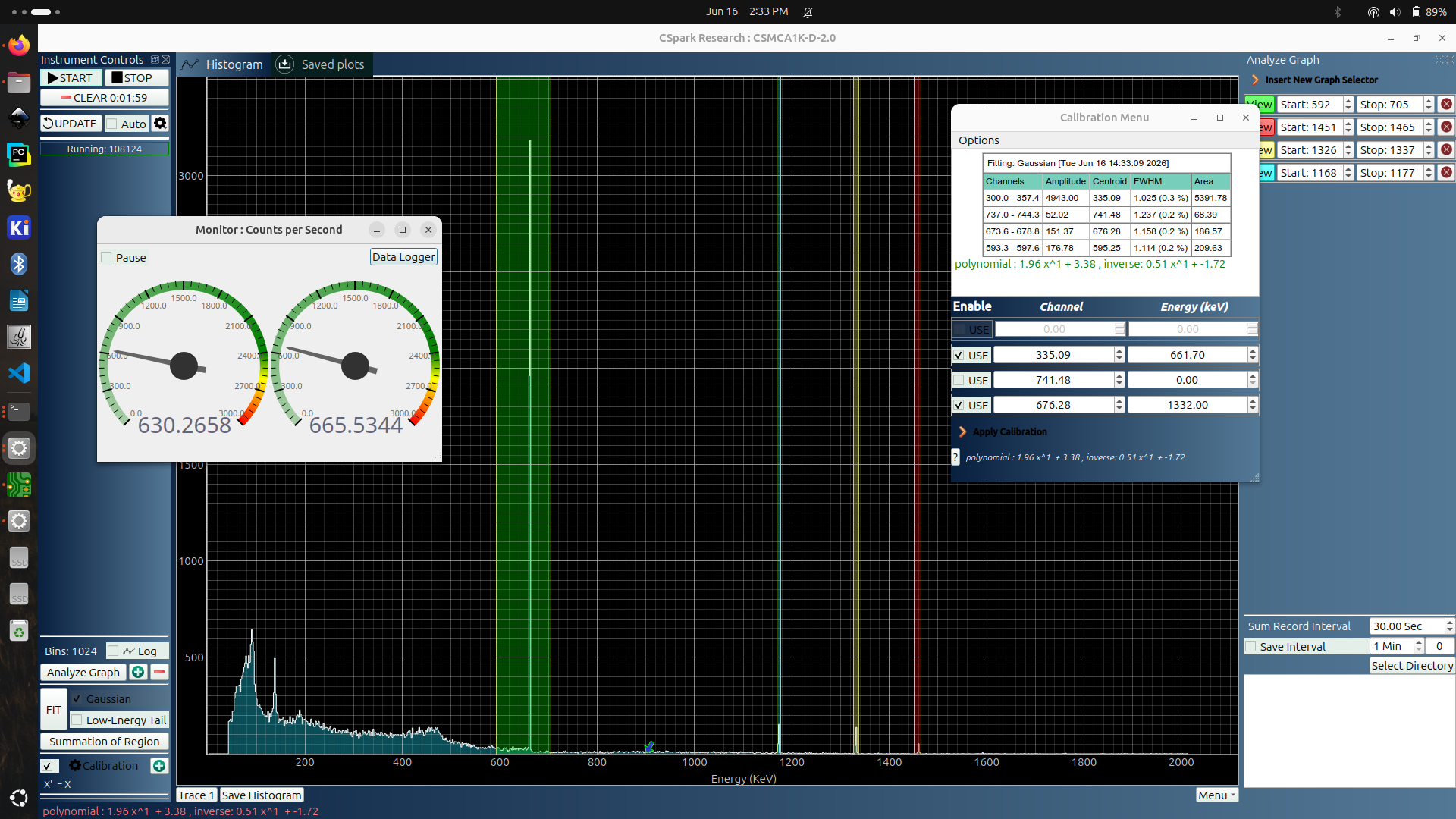
To rigorously evaluate Integral Non-Linearity (INL) and test performance across a broad energy envelope, I exposed the system to a complex, mixed radioactive source containing Cobalt-60 (60Co), Cesium-137 (137Cs), and Potassium-40 (40K). This cocktail covers a wide energy spectrum, extending from intermediate energies up to the high-energy terrain of environmental radiation. The K-40 was literally a jar of sand brought by a student of Dr E Prasad from the Central University of Kerala.
💡 Key Spectral Identifiers Tracked:
- 137Cs characteristic single photopeak at 661.7 keV
- 60Co distinct cascading twin peaks at 1173.2 keV and 1332.5 keV
- 40K environmental background line at 1460.8 keV
Mapping the centroid channel of each peak against its universally accepted literature energy yielded an exceptionally tight linear fit, proving that the combined analog-to-digital system delivers negligible distortion over the entire 16,384-channel space.
Conclusion
Scaling up to a 16K Multi-Channel Analyzer introduces severe engineering constraints regarding noise management, differential linearity, and high-speed analog tracking. By leveraging open-source hardware simulation routines in KiCAD alongside reliable industrial digital platforms like the BSI BOSON, I have successfully developed a good acquisition framework optimized for high-purity semiconductor detectors. Net cost is under 250$ for a commercial 16K unit with the software which I have released under open source terms at https://github.com/csparkresearch/cnspec.
This hardware will soon be available via my Startup CSpark Research: https://csparkresearch.in/mca1k