Experiments with MTP10-A6F55D PIR temperature sensor

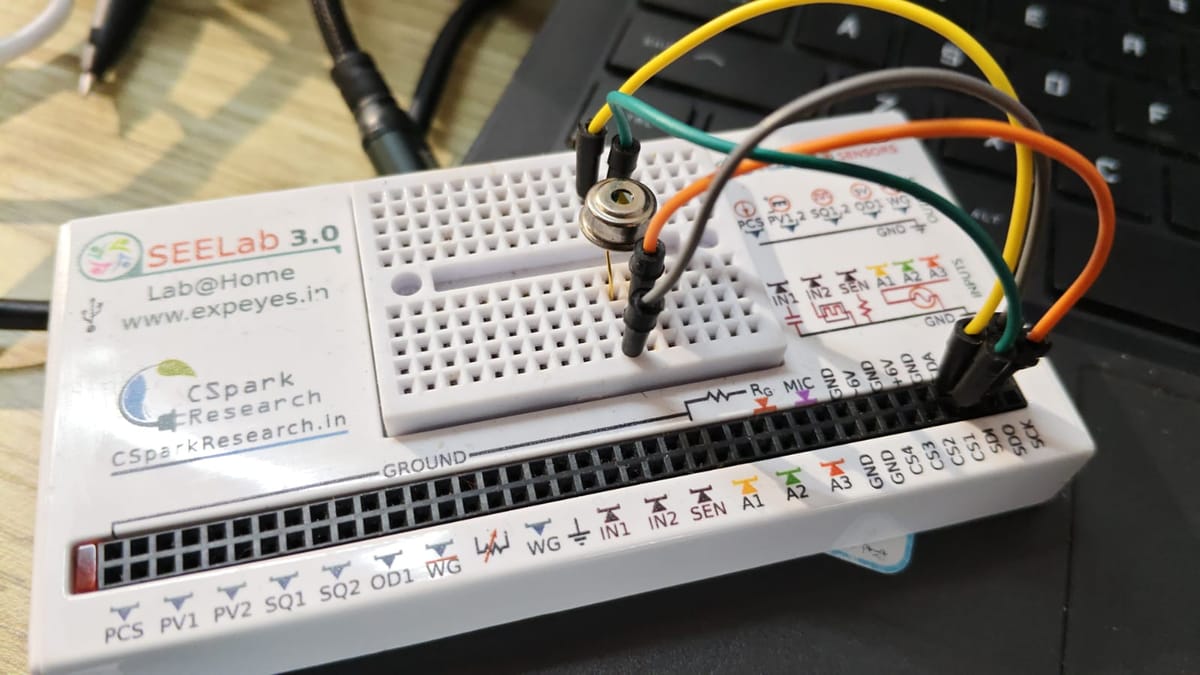
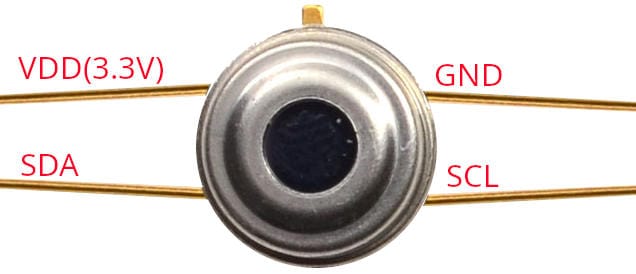
Connections: Connecting for I2C communication is straightforward. Use CS1 for power supply since the sensor can only take up to 3.6V max power supply.
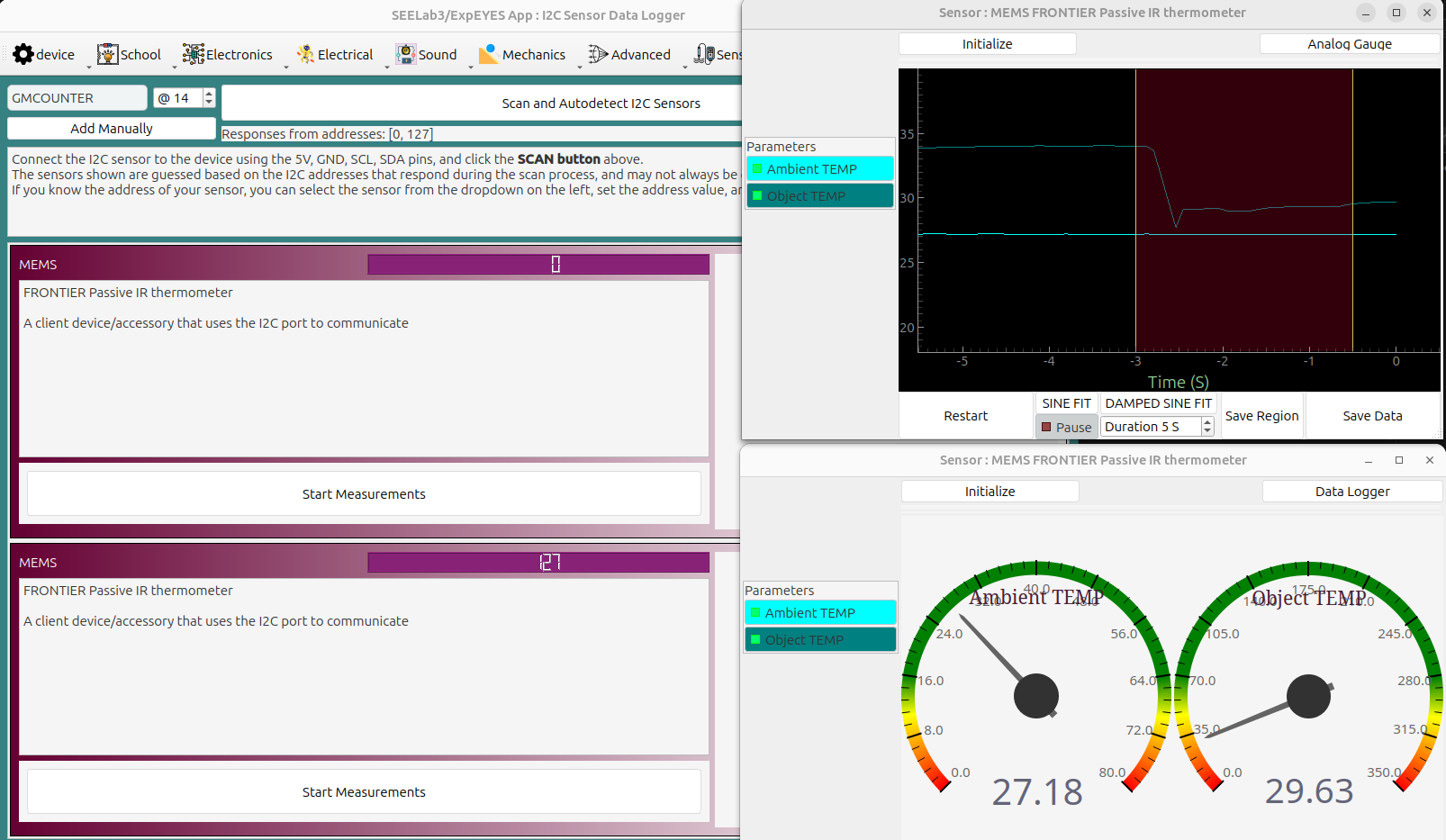
The user interface in the sensor logger will show 3 gauges :
Object Temperature : Temperature derived from the incoming long range IR light.
Ambient Temperature: Temperature of the sensor itself which is used as a reference.
Raw Values: Raw readings from the thermopile which should have a 4th power relation with the object temperature
Experiments possible with this sensor
Unlike standard thermistors or IC sensors that track their own internal temperature (Ta), the MTP10 uses a thermopile matrix to capture incoming long-wave Infrared (LWIR) radiation. This allows it to instantly calculate the absolute surface temperature of a remote object (To) without touching it.
Here are four high-impact science experiments you can perform using the MTP10 sensor with SEELab3’s real-time plotting features.
1 . Verifying Stefan-Boltzmann’s Radiation Law
The fundamental physics behind non-contact temperature sensors relies on the Stefan-Boltzmann law, which states that the total energy radiated per unit surface area of a black body is directly proportional to the fourth power of its absolute temperature:
$$E = \sigma T^4$$
The Experiment:
- Fix the MTP10 sensor pointing toward a flat metal plate or a container of water.
- Heat the water/plate gradually while monitoring the real-time object temperature (To) and the raw voltage values(RAW IR) .
- Set Gain to 128x and OSR to maximum when dealing with small temperatures
- Export the data and plot the measured radiative voltage signal against $To^4$ (converted to Kelvin).
You can visually verify the non-linear, $T^4$ behavior of thermal radiation. Explore Scipy for curve fitting and error analysis.
What to expect:
- Positive Raw IR Values (Target > Sensor Temperature): When pointing the sensor at an object hotter than the room (like a hot water cup or a human hand), the net IR flux flows into the thermopile. The raw value will scale up significantly into positive territory. By how much will depend on your configured Gain setting.
- Zero Raw IR Value (Target == Sensor Temperature): When the target object is at the exact same temperature as the sensor chip itself (To=Ta), there is no net thermal radiation exchange. The raw IR reading will hover right around
0(with minor noise fluctuations). - Negative Raw IR Values (Target < Sensor Temperature): If you point the sensor at an object colder than the room (such as a block of ice or liquid nitrogen container), the sensor chip radiates net energy outward toward the cold object. The thermopile voltage reverses polarity, causing the raw value to drop below zero into negative counts.
2. Investigating Leslie's Cube & Surface Emissivity
Why do some objects feel hotter or radiate more efficiently than others at the exact same temperature? This experiment explores emissivity (ϵ)—an object's effectiveness in emitting energy as thermal radiation.
The Experiment:
- Take a square metal container (or a makeshift Leslie's cube) and coat its four vertical sides with different surface finishes: shiny polished metal, matte white tape, textured aluminum foil, and matte black paint.
- Fill the container with boiling water so that all four surfaces are at an identical thermal equilibrium.
- Position the MTP10 at a fixed distance from each surface sequentially and record the reported object temperature (To).
Even though the physical temperature of the container is uniform, the MTP10 will read a significantly lower temperature on the shiny metal surface compared to the matte black surface. This demonstrates how low-emissivity surfaces reflect ambient infrared rather than emitting their own
3. Real-Time Thermal Dynamics and Newton’s Law of Cooling
With the MTP10's high oversampling rates (up to 16384x accessible via SEELab), you can capture rapid thermal transitions without the thermal lag associated with traditional glass or digital probe thermometers.
The Experiment:
1. Point the MTP10 sensor at a heated object (such as a ceramic resistor driven by a SEELab programmable voltage source, or a small cup of hot water).
2. Start the SEELab real-time graph and let the object cool down naturally to room temperature ($T_a$).
3. Fit an exponential decay curve to the plotted data to verify Newton's Law of Cooling:
$$\frac{dT}{dt} = -k(T - T_a)$$
Where:
- $T$ is the temperature of the object at time $t$
- $T_a$ is the ambient temperature (read directly from the sensor's internal channel)
- $k$ is a positive constant characteristic of the system's surface area and material properties
What you Learn: You can calculate the cooling constant $k$ instantly. By repeating the experiment under different conditions—such as running a mini fan to introduce forced convection—you can directly analyze how structural variables change the rate of heat dissipation using the integrated form:
$$T(t) = T_a + (T_{\text{initial}} - T_a)e^{-kt}$$
4. Measuring Atmospheric IR Absorption & Greenhouse Analogies
Infrared radiation interacting with different gases is the foundation of atmospheric science and climate modeling. The MTP10 operates precisely in the long-wave IR band where gases like carbon dioxide ($CO_2$) and water vapor absorb radiative energy.
The Experiment:
- Align the MTP10 sensor facing a steady, warm thermal source (like a heated metal block) at a distance of about 20–30 cm.
- Place a transparent plastic chamber or a sealed tube between the sensor and the thermal source.
- Fill the chamber with normal ambient air and record the baseline temperature or raw IR counts ($I_0$).
- Slowly flood the chamber with $CO_2$ gas (easily generated using baking soda and vinegar in a separate flask). Watch the immediate attenuation of the registered raw IR voltage signal ($I$).
Observe how an optically transparent gas can be highly opaque to infrared radiation. By testing different path lengths ($x$) or concentrations ($c$), advanced students can even model the behavior using the Beer-Lambert law:
$$I = I_0 e^{-\alpha c x}$$
Where:
- $I$ is the transmitted radiant intensity
- $I_0$ is the initial radiant intensity
- $\alpha$ is the absorption coefficient of the gas
This is a striking demonstration of the greenhouse effect on a tabletop scale.
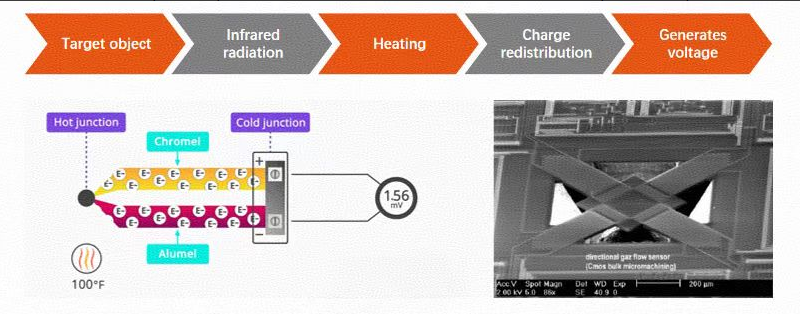
Infrared Thermopile Temperature Measurement Solution
The infrared thermopile temperature sensor uses the thermopile effect (Seebeck effect) to measure temperature. The principle is based on the energy conversion between infrared radiation emitted by an object(black body) and thermoelectric materials. When an object above absolute zero radiates infrared radiation, the thermopile sensor receives this radiation through an array of thermocouples. Different wavelengths of infrared radiation correspond to different temperatures. The sensor uses a filter to select specific wavelengths and converts the received infrared radiation into a voltage signal which is then digitized and read out by SEElab3
achieves ≥80% transmittance in the 5.5-14μm band and a 1% cutoff below 5μm, effectively shielding against short-wavelength infrared interference and improving measurement stability in complex environments.